Jun 2nd | Summer Social

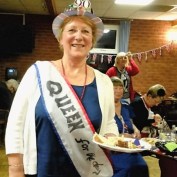
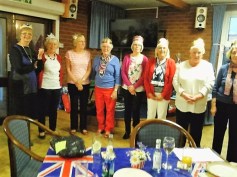
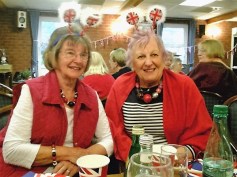
Early June and it was our Summer Social evening, with food, a quiz and a home-made crown competition to celebrate the Queens 90th birthday. All went well until poor Pat Naylor tripped up the edge of the stage in the Vine Lounge and unfortunately suffered a broken ankle as a result. Get well soon, Pat! Margaret Chenery won the crown competition and Pat Bradford was the runner up, whilst Mary Butters and Penny Thompson came first in the quiz.

20160602_200703

20160602_214958

20160602_210042

May 19th | Visit to Tattingstone Garden Centre

Tattingstone Garden Centre visit - May 2016 010

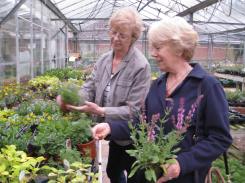
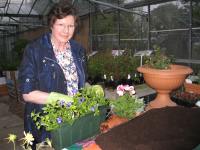
Jacky and Di choosing plants

Jacky and Di choosing plants

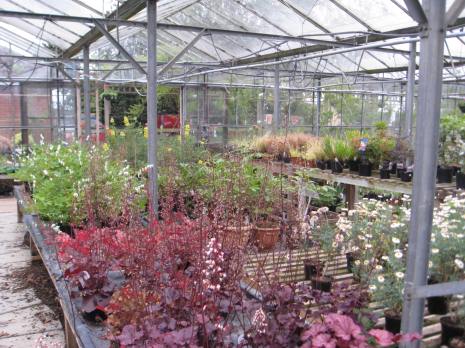
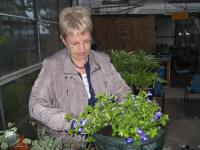
Fourteen of us went to Tattingstone Garden Centre on a cool but dry evening in May. We had come to create our own planted hanging basket or tub, choosing and using some of the wide selection of bedding plants available there.

First of all Lorraine and Brandon between them gave us a demonstration whilst telling us about the different plant foods, irrigation systems and types of compost available. Then we were set free to do our own thing, and we enjoyed filling our own containers to produce both colourful and attractive results.

Teas, coffees and cake were served, and after some more informal questions and answers we paid for our trophies and left.

Thank you to Lorraine and Brandon for a most enjoyable and productive evening! Tattingstone Garden Centre is well worth a visit!

Beryl finishing her window box

Beryl finishing her window box

Wendy adds the final plant to her basket

Shirley’s finished basket


May 16th/18th | Badger Watching

In addition to our scheduled outing this week, we booked two evenings with the Suffolk Wildlife Trust to go Badger Watching at a secret location on the outskirts of Ipswich, and both groups were very lucky in that they both saw badgers!

The first group of 8 went on Monday 16th May, and this is what they wrote:

As predicted we arrived at the car park about 6.45pm , collected the key and a bowl of peanuts and walked to the hide arriving there about 7pm. Steve threw peanuts (to which badgers are apparently rather partial) down the bank  in front of the hide window and we all took our places. There were several information sheets to read around the inside of the hide which was at the top of a bank overlooking some very large holes and a stream, with lots of leafy trees and roots.

Three great tits, a few rats and almost an hour later the first badger appeared up the bank in front of us. She, and I am sure it was a she, was quickly followed by three very cute youngsters and we all sat in an enthralled silence for the best part of half an hour while they rooted around for the strewn peanuts. Just before we thought we might leave, the boar put in a brief appearance but unfortunately he didn’t stay long.

I am sure we all left feeling very privileged.

The second group went on Wednesday 18th May, here is their report:

We took our places just after 7.00 p.m., having scattered the peanuts   around the front of the hide at the top of the bank. Just after 7.20 the first badger appeared. Not a cub, but we thought a juvenile as he or she was not very large. He spent about 25 minutes seeking out and devouring more than half of all our peanuts – to our dismay! But we needn’t have worried! Soon after he had shuffled off, a larger badger arrived. He appeared to have a plaited string collar around his neck, perhaps for identification? He had a kinked tailed so he was easy to distinguish from the other badgers, and he was larger so we presumed he was a male. He managed to find a few peanuts overlooked by the first badger, and then another badger joined him in the search. They completely ignored one another and eventually shuffled off one by one along their track and into the undergrowth. After a few more minutes a fourth badger arrived, who also seemed to have a collar round his neck, and had slightly different markings (pale patches) on his shoulders. He (or she) stayed quite a while hoovering up the final peanuts and generally sniffing around the area before leaving. We stayed for another half an hour but apart from a rat and great tits no sign of any more creatures, so we decided to leave – still in daylight – at 9.40 p.m., feeling, like the others, very privileged.

May 5th | ‘Frock Horror’ – talk by Pauline Baker

Our speaker in May was Pauline Baker, a dress designer who had gained her qualifications at Leicester College of Art. With her love of the performing arts she got a job at the Royal Opera House, Covent Garden, where to begin with she was a “finisher”, working on ballet costumes as part of a team. Here, she sometimes got to see some of the rehearsals in between sewing tasks, including at one time Rudolph Nureyev and Margot Fonteyn!

After this she worked as a maintenance wardrobe master, responsible for supervising all wardrobe-related activities during the course of a theatrical run including the care and proper maintenance of all costumes, shoes, undergarments, hats and personal props such as gloves, jewellery, boots and wigs.

She became a dresser again and was back to sewing costumes, working at the BBC Studios at Shepherds Bush as well as at Ealing Studios. After a break in her career to have her family she decided to go freelance and worked for different television companies on various drama series in a number of locations.

Pauline recounted several anecdotes about her experiences. She told how she once had to go with a female impersonator to buy him a pair of stilettos, much to the embarrassment of the girl in the shop. On another occasion one of the actors went home with the costume earrings on and lost one. Pauline went out and tried without success to buy a similar pair, which meant all the camera angles for the next day’s filming had to be changed so that only one side of the actor’s face could be seen at a time, or else the actor had to have their hand up to cover the naked ear! She once had to borrow an item from one of the guests staying in a hotel where they were filming, and keep her fingers crossed that all the takes filmed that day were good ones that didn’t need re-doing, in case the guest left with the item before the end of filming!

Continuity was very important and sometimes difficult to maintain, as the limited use of a particular location meant that all the parts of the story in that location had to be filmed at the same time, even though it might be months apart in the narrative. Thus the costumes had to be fresh in some scenes and the worse for wear in others. When the costumes involved had to appear old or crumpled, Pauline had to “break them down”, sometimes by putting them in a bin liner and jumping up and down on them. Once she asked the mechanics at a garage near the studios to “wear-in” some overalls needed for the filming, so she often had to use her own initiative to come up with what was required. Altogether it was an amusing and interesting talk which opened our eyes to some of what goes on behind the scenes in the world of entertainment!

Future entertaining activities for Capel Ladies include our Summer Social, Fun Day Stall, evening river cruise and a walk at Felixstowe. See anything you like? Then join us!

Apr 28th | Visit to Museum of East Anglian Life, Stowmarket

IMG_2605

The Museum of East Anglian Life is one of the biggest Museums in Suffolk, occupying over 80 acres of countryside in the heart of Stowmarket.

The land was originally part of the Home Farm for the Abbot’s Hall estate, an outlying medieval manor of St Osyth’s Priory in Essex. It passed through numerous owners until it was purchased by the Longe family in 1903.

Huge changes in the 1950s and ‘60s meant England was in danger of losing long established skills, equipment and buildings if something was not done to rescue them. Individual collectors, local farmer Jack Carter and the Suffolk Local History Council worked to collect, preserve and display objects from rural East Anglia. After several years of temporary exhibitions the Misses Vera and Ena Longe placed 70 acres of farm land, Abbot’s Hall and its gardens, as well as 18/20 Crowe Street, in trust to be used as a Museum.

And so – the Museum of East Anglian Life opened in 1967 and is a modern memorial to this foresight and vision.

The party of Capel Ladies (plus 2 Capel Gents!) began their visit with a delicious lunch at the on-site Osier Cafe, where an ex-member, Joan Molle, joined us for the meal.

Our guide Catherine then took us into the huge tithe barn to tell us the story of how the museum began, and how it has evolved since, with additional buildings being moved from their original locations and re-erected on the museum site. One of these was Alton Water Mill – moved from Tattingstone before Alton Water reservoir was created!

We then walked to Crowe Street Cottages, 2 semi-detached dwellings near the entrance to the museum, which had been built in the early 18th century as farm-workers cottages, and which had been occupied until the 1960s. Catherine then told us the story of the last family to live there, the Wildings, and what the property had been used for over the years. Much of their furniture and belongings were still to be seen, and in some rooms it was as if the family had just popped out for a minute and were expected back at any time! Mrs Emily Wilding had been the Head Cook at Abbot’s Hall, and her husband was Head Horseman. The cottages had been their family home and then a dairy where Mrs Wilding made butter, and from where she sold the spare milk at the door to people who called with a jug or a bottle.

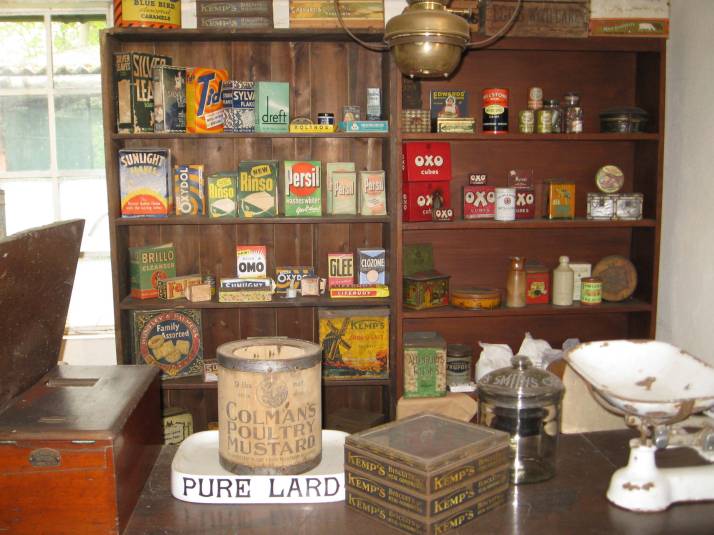
After this we were free to explore buildings and displays on the rest of the site, and the exhibits we saw included a Victorian schoolroom, some shops laid out like the early ‘50s, and a collection of gypsy caravans. There was so much to see none of us could do it justice in the time remaining, but after this taster we all decided that we would each pay a further visit later in the year. There is lots happening in 2016 – Abbot’s Hall was voted Suffolk’s Museum of the Year 2015, and many exciting events are planned for this year!

This slideshow requires JavaScript.
Apr 7th | Encouraging Wildlife in your Garden – James Baker

We can all do our bit for wildlife, be it ever so small, from making a log-pile, allowing a section of our lawns to grow long grass, or putting out water for a bird bath. “Every little helps” as they say, and this was the message put across by our April speaker, James Baker, from the Greenways Conservation Project in Ipswich.

“Greenways” exists to encourage and promote conservation groups and activists in the Ipswich area. It is an organisation which relies heavily on voluntary help to conserve, improve and protect areas of different habitats both for the creatures which live there as well as for the public to enjoy.

Through their work locally, places like Kiln Meadow, south of Ipswich, (at one time destined for mass housing) and Spring Wood near Belstead have become sanctuaries for many different species whose populations might otherwise have died out. These various conservation areas don’t just work in isolation from each other. Creatures need to commute between them, and that is where garden owners come in. No matter how small a plot you have at the rear of your house, by introducing a wildlife-friendly element into it you will have provided a stepping stone or even a bridge which will help a small creature to move between sites and interact with others of its kind.

At the moment the big worry is the decline in our hedgehog population, and we can help here too. Simply by making it possible for a hedgehog to access our gardens by creating gaps in our boundary fences or digging a small hole which passes underneath, we are opening a new hedgehog food store where there are slugs and worms a-plenty on offer! (Please don’t use slug pellets, by the way – they are poisonous to hedgehogs!) Siting a hedgehog house in a corner of the garden may well attract a needy hedgehog in the autumn, or as an overnight guest! And not only hedgehogs – the house can also shelter other small creatures such as spiders or bees. James’s talk certainly inspired us all to try and do more for our wildlife! For more information about Greenways please visit their website:   www.greenlivingcentre.org.uk/greenways

War Memorial Fund

War Memorial contribution cheque presentation, April 7th 2016

The planned war memorial in Capel will cost around £12,000 at least, so the War Memorial Group are always delighted to receive donations towards this. Capel Ladies have given £100.00 for this worthy cause, and Bill Diamond and Griff John came to our meeting in April to receive the cheque officially from our Treasurer Liz Gulliver and Chairlady Linda Evans. There is still a long way to go, of course, but at least the plans are in place.

Mar 17th | Meal at The Brook, Washbrook

There was a jolly atmosphere at our meal out at The Brook in Washbrook. There were twenty-five of us in our group, plus around twenty other diners, and the staff coped very well. One or two people had problems with their meals but these were sorted out and those who had been affected were given free drinks and replacement servings. We all raised our glasses for a photo taken to celebrate the forthcoming 90th birthday of the Queen, and which you will see here. Cheers!

Mar 3rd | Talk by Woodcarver Maureen Midwinter

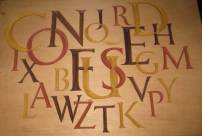
Maureen's Test Piece - Carving of the Alphabet

Maureen’s Test Piece – Carving of the Alphabet

Woodcarver Maureen Midwinter grew up in an artistic family as her father was a cartoonist, and she always loved to draw. However it wasn’t until after her children grew up and left home that she decided to give up her career as a nurse and take up the hobby of woodcarving. She told us she had been inspired after finding a piece of tree root shaped like a snake in Beddgelert Forest whilst on holiday in Wales.

008

Maureen trained at Suffolk College to begin with and then moved to London where she lived in a cold, semi-basement in Kennington as a student, taking her City & Guilds exams at the London School of Art. It was back to basics, with lots of drawing and lettering practice – lettering is a vital skill used all the time by anyone carving in stone or wood. She had to produce a sample piece of work which had all the letters of the alphabet in, and she carved them in a jumbled group with the word “CONFUSED” standing out amongst them.

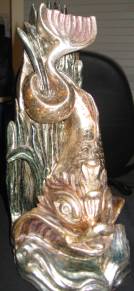
Carved Dolphin with Silver Coating

Carved Dolphin with Silver Coating

Deil's Head

Devil’s Head

Maureen has amassed her own collection of 125 tools, some of them very old. Each one has a different function, and a different way of being sharpened – also a skill! She told us all about the lengthy processes of producing a piece of sculpted wood and the different methods of treating and colouring it to create the finished item. Sometimes she uses gold leaf which is very delicate and feather-like and very painstaking to apply. She has also used silver and coloured plasters of various complicated mixes to give different effects, depending on what she is making.

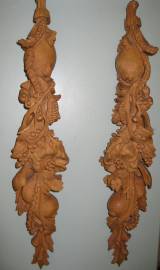
Two "drops" carved in symmetry

Two “drops” carved in symmetry

She uses different woods – including oak, yew, acacia, lime, box and mahogany. Each is suitable for a particular purpose. Amongst the things she has created are replacement carvings for ones which were missing or fire-damaged, in buildings such as Brighton Pavilion, St Paul’s Cathedral and Hampton Court. She has made carved frames for pictures and mirrors, a bench-end to replace a damaged one in St Mary’s Church, Great Bealings, and a wonderful coat-of-arms for the Worshipful Engineers Company to go in their Hall in the City of London. My personal favourite was the village sign for the Bealings villages. It has a front and a back, one showing Great Bealings and one Little Bealings, with their churches and other village features clearly shown. What a talented lady!

Feb 18th | Visit to Suffolk Record Office

Visit to Suffolk Records Office, Ipswich, on 18/2/16 by Capel Ladies Club

Our first outing of the year was an evening visit to the Suffolk Record Office in Ipswich, where our guides Heather Marshall and Bruce Martin took it in turns to tell us something of the work they do. It is their responsibility to maintain and look after original documents from many different sources, including published works like histories, poetry and newspapers, maps and charters, wills and letters, and to get them out on request for visitors to see. Items can even be brought down from the strong room to be placed on stands and cushions on large tables in the map room or the hall of the Record Office for people to examine.

Many of these documents are very old and fragile, and have to be kept in controlled conditions in the strong room, protected by large fire doors where the temperature and humidity levels are constant, so that the records don’t crumble away or go mouldy. We were allowed to enter the strong room where Heather showed us some ancient maps of the area, some of them in huge cylinder-shaped leather boxes. We saw copies of the local Ipswich paper all bound in volumes and going back two or three hundred years. One of the oldest documents was a town charter for Ipswich drawn up in the time of Henry I and copied out by monks on thick manuscript, with a huge seal at the bottom and illuminated letters at the top.

Some records have been photographed and transferred to micro-fiches which can be accessed on screens that can be scrolled through so that you can examine a particular Census or Parish document.

Capel Ladies were made very welcome by Heather and Bruce, who had brought out a number of records, maps and documents to do with Capel, from old maps of the village to the school Log Book, and we spent a most interesting time poring over them all. So much so, in fact, that before we knew it the time was up and we had to leave. I’m sure that some of us will return to the Record Office at some point to carry on where we left off – and to probe further into Suffolk’s fascinating history.

(The Record Office is open every day except Sundays, Wednesdays and Bank Holidays, from 9.30 – 4.30 p.m., and access is free of charge, although you will have to sign in when you visit and you need proof of identity with you.)

Feb 4th | Hand & Nail Care – with Kay Oxford

006There was a good turnout for our first meeting of 2016 to hear Kay Oxford telling us about how to look after our hands and nails and showing a small group how to give themselves a basic manicure.
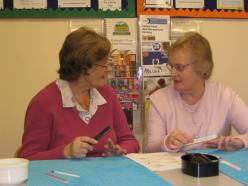
Kay began by telling us a bit about herself. She trained at Suffolk College, and did her work experience at Shrubland Hall, near Ipswich. Later she was asked back there to work over one summer, and ended up staying for five years.

005She also worked at a gym in Manningtree doing aerobics and step classes as well as beauty therapy. For a while she became a mobile beauty therapist in the Ipswich area but as this involved a lot of evening sessions she gave it up and decided to open her own beauty salon in Ipswich – “The Gentle Touch” in Crown Street, where she has been for the past fifteen years.
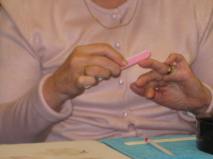
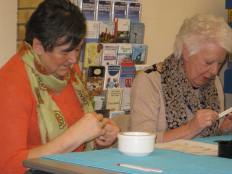
007Kay began by getting us to name all the different parts of the nail by filling in the labels on a quiz sheet, and then talked about the different ailments affecting nails. She went on to describe step by step how to give yourself a basic manicure, and a small group of us (chosen by names in a hat) worked through each step as she talked.
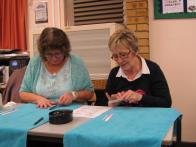
It was a very relaxed and informative session, and I’m sure all our nails will benefit from this gentle and correct treatment if we follow Kay’s advice.

004On the same evening Magdeleine Hunt was selling her own handmade jewellery and crafts, and many of us bought necklaces and other pretty items from her in aid of AGE UK.

Future speakers include a lady woodcarver, a wildlife expert and a theatrical costume designer, and we have trips out to the Ipswich Records Office, The Brook Inn for a meal, and Stowmarket Rural Life Museum. Why not join us?