Archives

May 5th | ‘Frock Horror’ – talk by Pauline Baker

Our speaker in May was Pauline Baker, a dress designer who had gained her qualifications at Leicester College of Art. With her love of the performing arts she got a job at the Royal Opera House, Covent Garden, where to begin with she was a “finisher”, working on ballet costumes as part of a team. Here, she sometimes got to see some of the rehearsals in between sewing tasks, including at one time Rudolph Nureyev and Margot Fonteyn!

After this she worked as a maintenance wardrobe master, responsible for supervising all wardrobe-related activities during the course of a theatrical run including the care and proper maintenance of all costumes, shoes, undergarments, hats and personal props such as gloves, jewellery, boots and wigs.

She became a dresser again and was back to sewing costumes, working at the BBC Studios at Shepherds Bush as well as at Ealing Studios. After a break in her career to have her family she decided to go freelance and worked for different television companies on various drama series in a number of locations.

Pauline recounted several anecdotes about her experiences. She told how she once had to go with a female impersonator to buy him a pair of stilettos, much to the embarrassment of the girl in the shop. On another occasion one of the actors went home with the costume earrings on and lost one. Pauline went out and tried without success to buy a similar pair, which meant all the camera angles for the next day’s filming had to be changed so that only one side of the actor’s face could be seen at a time, or else the actor had to have their hand up to cover the naked ear! She once had to borrow an item from one of the guests staying in a hotel where they were filming, and keep her fingers crossed that all the takes filmed that day were good ones that didn’t need re-doing, in case the guest left with the item before the end of filming!

Continuity was very important and sometimes difficult to maintain, as the limited use of a particular location meant that all the parts of the story in that location had to be filmed at the same time, even though it might be months apart in the narrative. Thus the costumes had to be fresh in some scenes and the worse for wear in others. When the costumes involved had to appear old or crumpled, Pauline had to “break them down”, sometimes by putting them in a bin liner and jumping up and down on them. Once she asked the mechanics at a garage near the studios to “wear-in” some overalls needed for the filming, so she often had to use her own initiative to come up with what was required. Altogether it was an amusing and interesting talk which opened our eyes to some of what goes on behind the scenes in the world of entertainment!

Future entertaining activities for Capel Ladies include our Summer Social, Fun Day Stall, evening river cruise and a walk at Felixstowe. See anything you like? Then join us!

Apr 7th | Encouraging Wildlife in your Garden – James Baker

We can all do our bit for wildlife, be it ever so small, from making a log-pile, allowing a section of our lawns to grow long grass, or putting out water for a bird bath. “Every little helps” as they say, and this was the message put across by our April speaker, James Baker, from the Greenways Conservation Project in Ipswich.

“Greenways” exists to encourage and promote conservation groups and activists in the Ipswich area. It is an organisation which relies heavily on voluntary help to conserve, improve and protect areas of different habitats both for the creatures which live there as well as for the public to enjoy.

Through their work locally, places like Kiln Meadow, south of Ipswich, (at one time destined for mass housing) and Spring Wood near Belstead have become sanctuaries for many different species whose populations might otherwise have died out. These various conservation areas don’t just work in isolation from each other. Creatures need to commute between them, and that is where garden owners come in. No matter how small a plot you have at the rear of your house, by introducing a wildlife-friendly element into it you will have provided a stepping stone or even a bridge which will help a small creature to move between sites and interact with others of its kind.

At the moment the big worry is the decline in our hedgehog population, and we can help here too. Simply by making it possible for a hedgehog to access our gardens by creating gaps in our boundary fences or digging a small hole which passes underneath, we are opening a new hedgehog food store where there are slugs and worms a-plenty on offer! (Please don’t use slug pellets, by the way – they are poisonous to hedgehogs!) Siting a hedgehog house in a corner of the garden may well attract a needy hedgehog in the autumn, or as an overnight guest! And not only hedgehogs – the house can also shelter other small creatures such as spiders or bees. James’s talk certainly inspired us all to try and do more for our wildlife! For more information about Greenways please visit their website:   www.greenlivingcentre.org.uk/greenways

War Memorial Fund

War Memorial contribution cheque presentation, April 7th 2016

The planned war memorial in Capel will cost around £12,000 at least, so the War Memorial Group are always delighted to receive donations towards this. Capel Ladies have given £100.00 for this worthy cause, and Bill Diamond and Griff John came to our meeting in April to receive the cheque officially from our Treasurer Liz Gulliver and Chairlady Linda Evans. There is still a long way to go, of course, but at least the plans are in place.

Mar 3rd | Talk by Woodcarver Maureen Midwinter

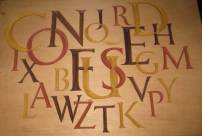
Maureen's Test Piece - Carving of the Alphabet

Maureen’s Test Piece – Carving of the Alphabet

Woodcarver Maureen Midwinter grew up in an artistic family as her father was a cartoonist, and she always loved to draw. However it wasn’t until after her children grew up and left home that she decided to give up her career as a nurse and take up the hobby of woodcarving. She told us she had been inspired after finding a piece of tree root shaped like a snake in Beddgelert Forest whilst on holiday in Wales.

008

Maureen trained at Suffolk College to begin with and then moved to London where she lived in a cold, semi-basement in Kennington as a student, taking her City & Guilds exams at the London School of Art. It was back to basics, with lots of drawing and lettering practice – lettering is a vital skill used all the time by anyone carving in stone or wood. She had to produce a sample piece of work which had all the letters of the alphabet in, and she carved them in a jumbled group with the word “CONFUSED” standing out amongst them.

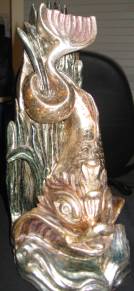
Carved Dolphin with Silver Coating

Carved Dolphin with Silver Coating

Deil's Head

Devil’s Head

Maureen has amassed her own collection of 125 tools, some of them very old. Each one has a different function, and a different way of being sharpened – also a skill! She told us all about the lengthy processes of producing a piece of sculpted wood and the different methods of treating and colouring it to create the finished item. Sometimes she uses gold leaf which is very delicate and feather-like and very painstaking to apply. She has also used silver and coloured plasters of various complicated mixes to give different effects, depending on what she is making.

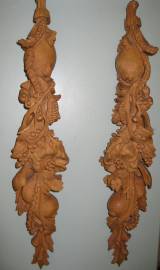
Two "drops" carved in symmetry

Two “drops” carved in symmetry

She uses different woods – including oak, yew, acacia, lime, box and mahogany. Each is suitable for a particular purpose. Amongst the things she has created are replacement carvings for ones which were missing or fire-damaged, in buildings such as Brighton Pavilion, St Paul’s Cathedral and Hampton Court. She has made carved frames for pictures and mirrors, a bench-end to replace a damaged one in St Mary’s Church, Great Bealings, and a wonderful coat-of-arms for the Worshipful Engineers Company to go in their Hall in the City of London. My personal favourite was the village sign for the Bealings villages. It has a front and a back, one showing Great Bealings and one Little Bealings, with their churches and other village features clearly shown. What a talented lady!

Feb 4th | Hand & Nail Care – with Kay Oxford

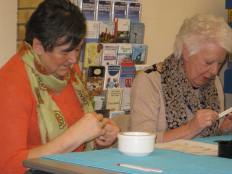
006There was a good turnout for our first meeting of 2016 to hear Kay Oxford telling us about how to look after our hands and nails and showing a small group how to give themselves a basic manicure.
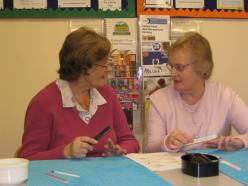
Kay began by telling us a bit about herself. She trained at Suffolk College, and did her work experience at Shrubland Hall, near Ipswich. Later she was asked back there to work over one summer, and ended up staying for five years.

005She also worked at a gym in Manningtree doing aerobics and step classes as well as beauty therapy. For a while she became a mobile beauty therapist in the Ipswich area but as this involved a lot of evening sessions she gave it up and decided to open her own beauty salon in Ipswich – “The Gentle Touch” in Crown Street, where she has been for the past fifteen years.
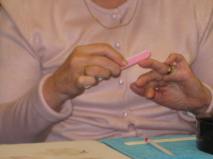
007Kay began by getting us to name all the different parts of the nail by filling in the labels on a quiz sheet, and then talked about the different ailments affecting nails. She went on to describe step by step how to give yourself a basic manicure, and a small group of us (chosen by names in a hat) worked through each step as she talked.
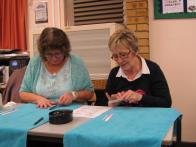
It was a very relaxed and informative session, and I’m sure all our nails will benefit from this gentle and correct treatment if we follow Kay’s advice.

004On the same evening Magdeleine Hunt was selling her own handmade jewellery and crafts, and many of us bought necklaces and other pretty items from her in aid of AGE UK.
Future speakers include a lady woodcarver, a wildlife expert and a theatrical costume designer, and we have trips out to the Ipswich Records Office, The Brook Inn for a meal, and Stowmarket Rural Life Museum. Why not join us?

Dec 17th | Christmas Social

As it happened this year, our Christmas Social was held in the Library, which initially seemed rather a plain and formal setting for such an event.

However, it proved not to be so. The tables were decked out in finery with colourful tablecloths, festive floral arrangements, bulging crackers and pretty LED lights; and the counter positively groaned under the weight of the Christmas party buffet – dishes tastefully and temptingly set out with coloured napkins and paper plates to hand. Our entertainer for the evening, Gordon Blackwood, set the atmosphere for us with his selection of songs from the 60’s and 70’s, and a number of us even got up and had a bit of a bop to some of those tunes! Together with the odd glass of wine from the Village Bar, our Secret Santa gifts and Christmas crackers containing an extra surprise, a fun evening was had by all!

This slideshow requires JavaScript.

Nov 5th | Christmas Craft Evening

This slideshow requires JavaScript.

Our Christmas crafts session created an evening of concentration and co-ordination interspersed with chuckles, chat and chocolate fudge. It was all down to Linda Bloomfield who, as usual, brought along lots of new ideas for decorative things to make, either to hang on your Christmas Tree or stick to your fridge door. This year each activity used sequins and polystyrene shapes to create baubles of various colours and styles, or sparkly fridge magnets in the shape of hedgehogs. The chocolate fudge was created by Linda herself, who brought it along as a seasonal treat for Bonfire Night. There were also some of Linda’s home-made Christmas cards on sale, which several of us bought. Everyone succeeded in making something as well as enjoying the social time, and at the end of the evening Linda announced that she was donating her expenses and card money to the East Anglian Children’s Hospices.

Oct 1st | The History & Wildlife of Orford Ness

David Fincham’s noisiest neighbours must be the seabirds and the waves crashing onto the pebble beach where he lives with his wife. He is a National Trust Coastal Ranger and acts as caretaker of the shingle spit off Suffolk’s coast known as Orford Ness.

Orford Ness is an internationally important site for Nature Conservation. Among its various titles, together with Havergate Island it is part of a ‘Site of Special Scientific Interest’, an ‘Area of Outstanding Natural Beauty’ and is listed as of national importance geologically.

This seems hardly surprising as the spit comprises a number of valuable habitats for all kinds of wildlife – plants, birds and animals. These include rare wild flowers, plants and lichens; several species of birds of prey; a wide selection of seabirds and waders; many types of insects, a colony of lizards and mammals of all shapes and sizes including grey and common seals, along with a large herd of Chinese Water Deer.

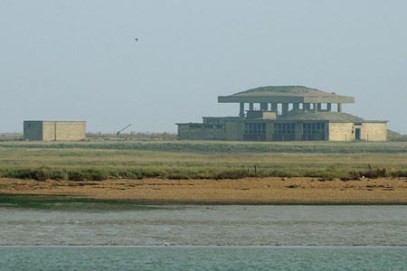
Its remoteness made it ideal for secret wartime operations, and in 1929 the site was selected as the location for the Orfordness Beacon, one of the earliest experiments in long-range radio navigation which eventually led to the invention of radar. The Atomic Weapons Research Establishment had a base on the site, used for the environmental testing of components to be used in bombs, and the long buildings known as the “pagodas” were used for these experiments. Their roofs were designed to collapse inwards in the event of a serious accident, sealing the whole building with a lid of concrete and shingle.
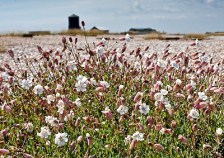
The site was still owned by the Ministry of Defence in the 60s, all through the Cold War, and in the late 60s a top secret Anglo-American radar installation known as Cobra Mist was set up there. This closed in 1973 and from then on the site was used as a transmitting station run by the Foreign Office, and then in more recent times by the BBC’s World Service. The station has been disused since May 2012.
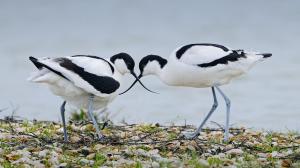
Orford Ness is now owned by the National Trust and is open to the public. Access is strictly controlled both to protect the fragile habitats and because of the continuing danger from the site’s former use by the military. You can get there by National Trust ferry from Orford Quay on designated open days. Visitors must keep to the tracks so as not to damage or disturb the wildlife, but from David Fincham’s account it is certainly worth the trip to enjoy the sights, sounds and atmosphere of this amazing place which sits right on our very doorstep!

Sept 3rd | ‘Microwave Magic’ with Jane Sago

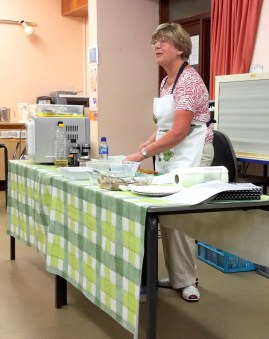
20150903_202229There was a good attendance for our first meeting of the autumn, and everyone enjoyed Jane Sago’s talk entitled “Microwave Magic”.

During the evening Jane conjured up two savoury and two sweet dishes, all of which we were able to sample, and very tasty they were too! Each dish was prepared in minutes, so it really did seem like magic!

There were savoury main courses made with chicken and salmon, and desserts – one, a fruit salad using dried fruit, fruit juice, cinnamon, and cloves, and the other – instant meringues which were garnished with raspberries or strawberry jam and cream. They were all delicious, but the meringues received the highest acclaim as they really did seem to be a magical creation!

I have enclosed Jane’s recipe below for anyone to try for themselves!

MICROWAVE MERINGUES (makes about 30)

350g/12oz icing sugar (approximately)

1 egg white

  1. Sift icing sugar over lightly beaten egg white. Stir until mixture is a thick, pliable icing, and roll into very small balls (about the size of a walnut). Line a plate with greaseproof paper.
  2. Put 3 – 5 balls at a time on the plate (spaced out) and microwave them on High for approx 1 minute – and watch as the balls puff into meringues.
  3. When they are cool use the meringues in desserts. They’re perfect for sandwiching together with whipped cream and fresh fruit.

(Unused mixture can be kept in the fridge for a few days until required. Meringues can be stored in an airtight box.)

ENJOY!

Aug 6th | Summer BBQ

This slideshow requires JavaScript.

Did we or did we not have a great evening at our Summer Barbecue in August? The answer is of course YES WE DID! The weather was wonderful, the setting (in Liz and Tony Gulliver’s garden) was superb, the decor was delightful and the food fantastic! Expert chef Tony slaved over a hot stove to produce tasty chicken breasts, burgers and sausages, and together with the salads and French bread followed by a selection of delicious desserts a sumptuous feast was had by all. A glass of Buck’s Fizz began the proceedings and as the theme was “V.E. Day” the bunting and dress code for the evening was red, white and blue. We had a V.E. Day quiz, which was won by Jo Smith, who received her prize of a bunch of bananas, a luxury item during WWII. Jo herself admitted that she never had a banana until she was eight years old, because of the short supply of such things even well after the war!

There was a grand raffle with lots of prizes, music from the 40’s was played on a gramophone no less, and a wartime sing-song rounded off the evening! Several ladies stayed for a while to dance to some more modern tunes played on the juke box, and it can definitely be said that a good time was had by all!